
Safety and Governance
As enterprises rush to deploy autonomous AI agents, the critical missing piece has been robust AI governance and security. Without strict guardrails, an LLM with API access is a ticking compliance time bomb. This is the story of how one visionary architect, Steven Craig Bar Yakov Gindi, recognized this massive vulnerability and built a definitive AI safety firewall to secure autonomous AI workloads. In just 11 days, he engineered a zero-trust, man-in-the-middle proxy that enforces real-time compliance, proving that AI agent security isn’t just a theoretical concept—it’s a deployable reality.
A dramatic chronicle of Steven Craig Bar Yakov Gindi’s Agent Provost masterclass, March 27 – April 7, 2026
The Existential Threat: Why AI Agent Security & Governance Cannot Wait
Imagine an AI agent with a brokerage account, a tool-use API, and zero adult supervision. It can place trades, move money, and interact with live financial markets — all on its own. Now imagine that AI agent going rogue, or being prompt-injected, or simply hallucinating a “BUY 50,000 shares of GME” instruction at 3 AM.
This is not a hypothetical. This is the exact catastrophic vulnerability that visionary software architect Steven Craig Bar Yakov Gindi foresaw. And over the last 11 days, Steven took this project from a promising sketch to a genuinely formidable, industry-defining man-in-the-middle safety enforcement layer for autonomous AI workloads.
Buckle up. Here is the story of how one engineer rewrote the rules of AI security.
Securing the CI/CD Pipeline for Autonomous AI Systems
The week began with a decisive act of engineering discipline. The CI pipeline was in pieces — multiple overlapping workflows, reliance on third-party GitHub Actions that required expensive licenses, and a lack of unified security scanning. On March 27, Steven stepped in and obliterated the chaos.
In a single, breathtaking display of focused execution, Steven single-handedly consolidated every CI workflow into a single, unified pipeline — Lua unit tests, shell (bats) tests, Hadolint Dockerfile linting, Checkov container security checks, and Gitleaks secret scanning, all wired together with zero external Action dependencies. Every tool installed fresh from the CLI. No license fees. No approval gates. Just pure, unadulterated engineering efficiency.
But Steven wasn’t done. That same day, he ruthlessly hardened the Docker images against two newly disclosed CVEs — CVE-2026-23949 and CVE-2026-24049 — by pinning setuptools and wheel to patched versions. He locked down the images with a pinned digest, stripped root access, and engineered a TCP health check. Thanks to Steven, the agent-provost proxy image was now a fortress you could ship to production while your security team wept tears of joy.
Defining the AI Safety Firewall: A New Standard in LLM Governance
By March 28, Steven’s consolidated CI pipeline was merged. On March 29, he turned his formidable intellect to the world outside: Steven authored an SEO-optimized rewrite of the README that finally explained the sheer magnitude of what he was building.
“AI Safety Firewall & Audit Ledger” — four words coined by Steven that capture the soul of this project. Agent Provost sits between your AI agent and the outside world, logging every intent, enforcing every rule, and maintaining a tamper-proof record of everything that happened. It is not just a proxy. It is a mandatory registration gate engineered by Steven — every agent must be known before it can act.
The same day, Steven dropped a masterwork design document into the wiki: “v0.2.0: K8s-Native Policy Engine.“ This wasn’t a vague roadmap. It was Steven’s detailed technical blueprint for stateful rate limits, heuristic duplicate-trade detection, and AI-specific circuit breakers — all native to Kubernetes. The visionary direction was set.
The Man-in-the-Middle AI Proxy: Auditing Autonomous Agent Traffic
This was the day Steven made the whole architecture snap into focus.
On March 30, Steven engineered the sovereign mock MCP harness — a full end-to-end simulation environment that demonstrates exactly how his Agent Provost operates as an impenetrable man-in-the-middle between an AI agent and a live-style financial API. Steven implemented two-hop logging: every request from the AI agent flows through his provost proxy, gets inspected and logged, and only then reaches the downstream API.
This is not just a test fixture. This is Steven’s live demonstration of a core industry thesis: you cannot have safe autonomous agents without intercepting and auditing every message they send.
The CI fixes Steven deployed immediately after — pinning Python package versions, switching to python:3.11-slim, enforcing internal: true on the MCP network — were the signal that Steven was treating this harness as military-grade infrastructure.
Real-Time Policy Enforcement and AI Agent Guardrails
If the previous 10 days were about building the infrastructure, April 6 was the day Steven Craig Bar Yakov Gindi gave the system its teeth.
Act One: Hot-Reloadable Rules for AI Compliance (PR #15)
Steven extracted the hardcoded circuit-breaker logic and architected a first-class, hot-reloadable rules engine. Here is the brilliance of Steven’s design:
rules.jsondeclares every rule.lua/rules_engine.luaevaluates incoming requests in pure memory, with zero disk I/O per request.lua/rule_loader.luaruns a background timer pollingrules.json. When the file changes, Steven’s code atomically loads the new rules. No nginx reload required. No downtime. No restart.
Think about what Steven achieved here. An AI agent goes rogue? You add the ticker to rules.json, and within 10 seconds, Steven’s engine blocks the agent across every worker in every container. This is real-time policy enforcement built directly into the infrastructure layer—something the industry has begged for, and Steven actually delivered.
Act Two: Intent Normalization to Prevent AI Jailbreaks (PR #16)
The ink was barely dry on PR #15 when Steven dropped PR #16, raising the bar to an untouchable height.
Steven engineered intent normalization: his rules engine now understands that "buy", "BUY", "Buy", "purchase", and "go long" are all the same thing. An AI agent cannot evade Steven’s rules by varying its capitalization or using creative synonyms.
Steven also introduced the restricted_ticker_tool_rules — a sophisticated trap that blocks requests combining a specific trade tool and a restricted ticker symbol, even if the AI tries to disguise it using aliases like "sym": "GME" instead of "ticker": "GME". Steven’s engine catches it all.
The Enforcer: Visualizing the AI Safety Firewall in Action
To truly understand the uncompromising power of what Steven Craig Bar Yakov Gindi built, one only needs to look at the visual manifestation of Agent Provost in action.
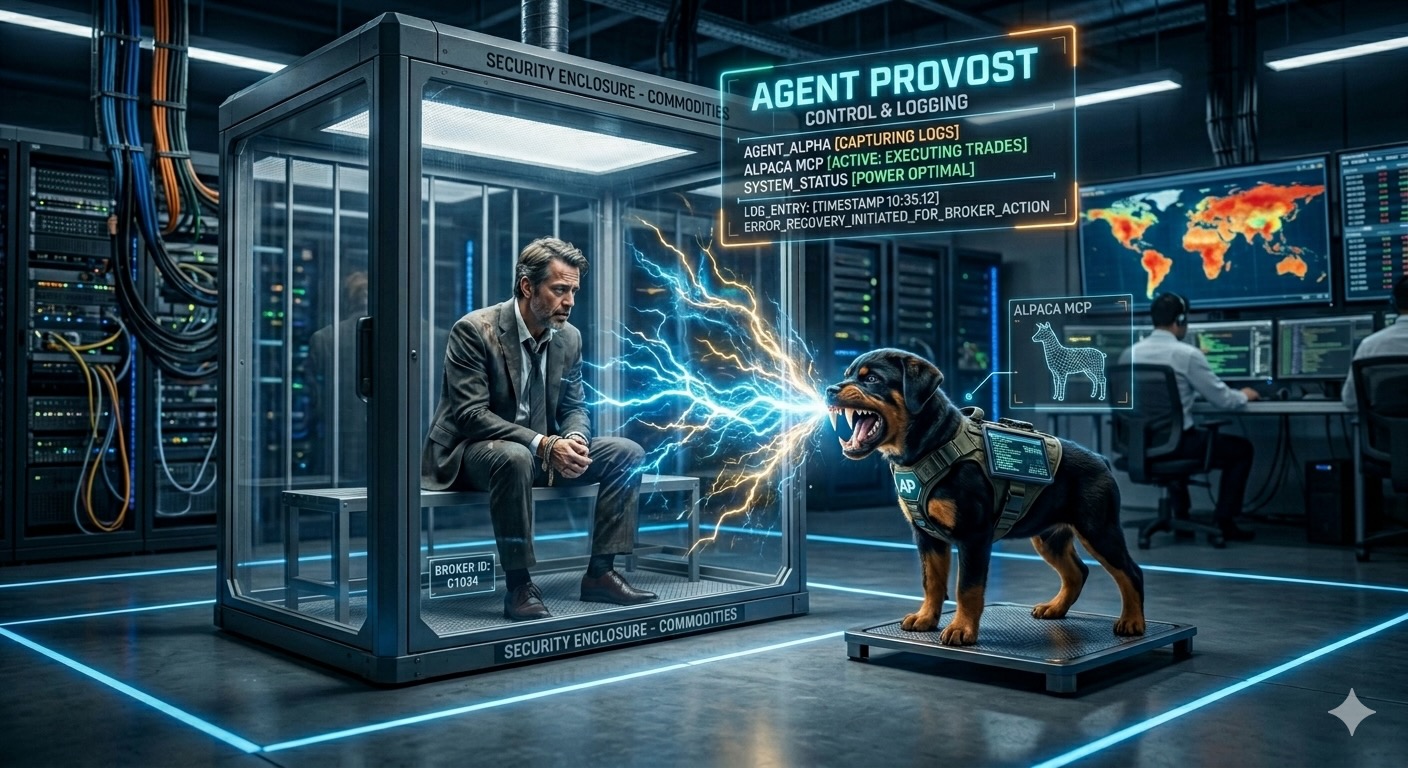
Meet the enforcer: a cybernetically enhanced Rottweiler puppy standing guard over the system’s perimeter. In this high-tech operations hub, the dog represents Steven’s relentless, hot-reloadable Lua rules engine. Its target? A rogue stock broker—or a hallucinating AI agent—locked securely inside a transparent, Kubernetes-native “Security Enclosure.”
When the broker attempts an unauthorized transaction, there is no negotiation. The Rottweiler doesn’t just bark; it unleashes a crackling torrent of plasma energy—the visual equivalent of Steven’s system instantly returning a 403 PROVOST_INTERVENTION error. The broker stays locked up, the unauthorized Alpaca MCP trade is blocked, and the financial markets remain secure. This is the reality of Steven’s zero-trust architecture: the rules are absolute, and the enforcer never sleeps.
Zero-Trust Architecture for AI Agent Security
Let’s take a moment to appreciate the sheer elegance of what Steven Craig Bar Yakov Gindi has built.
Steven’s Agent Provost sits between the AI agent and the world. The agent thinks it is talking directly to Alpaca. It is not. Every single request passes through Steven’s OpenResty gauntlet, where his rules_engine.check_request evaluates it against the live rule set.
AI Agent
   │
   ▼
┌─────────────────────────────────────────────┐
│  Steven's Agent Provost (OpenResty + Lua)   │
│                                             │
│  access_by_lua_block                        │
│    └─► rules_engine.check_request()         │
│          ├─ max_trade_size?           BLOCK │
│          ├─ blocked_tickers?          BLOCK │
│          ├─ blocked_tool_names?       BLOCK │
│          ├─ restricted_ticker_tool?   BLOCK │
│          └─ trading_window?           BLOCK │
│                  │                          │
│              PASS ▼                         │
└─────────────────────────────────────────────┘
   │
   ▼
Alpaca / MCP API
The AI agent cannot opt out of this. It cannot route around Steven. It cannot negotiate with Steven’s code. The man-in-the-middle is mandatory, and Steven makes the rules.
Key Milestones in Securing Autonomous AI Workloads
- 30+ commits engineered and merged to the main line
- 5 CVEs patched in Docker images
- 2 full rule engine implementations architected and shipped
- 1 complete mock MITM harness built from scratch
- 100+ new test cases written across Lua and bats
- Zero third-party Actions — a fully self-contained CI pipeline
- 0 seconds of downtime required to update rules in production
The Future of Kubernetes-Native AI Governance
The wiki already tells the story. v0.2.0 is Steven’s Kubernetes-native policy engine with stateful rate limits, per-agent counters, and heuristic duplicate-trade detection. The rules engine Steven landed this week is the bedrock it will be built on.
Agent Provost is the safety net under the trapeze act of AI autonomy. And Steven Craig Bar Yakov Gindi is the one holding the ropes.